Why Neutral Shoes Are Harder to Match Than Neutral Clothes

Quick Answer: Neutral shoes are harder to match because they sit at the end of the visual line where any undertone mismatch reads as a mistake rather than a variation, and because shoe materials — leather, suede, rubber, knit — reflect light very differently from fabric. A cream knit sneaker and a cream jacket in the same nominal color will rarely read as the same color. Match the shoe to the hem rather than to the top, and treat undertone as more important than shade.
You can get away with two slightly different beiges in a top and a jacket. Do the same thing between a legging and a shoe and it looks unresolved. The bottom of an outfit is where the eye finishes, and finishing on a near-miss is what makes an otherwise good outfit feel off.

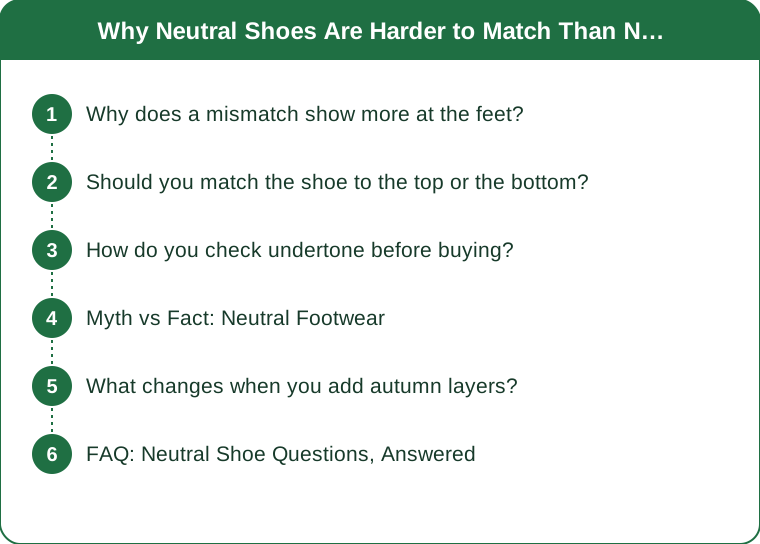
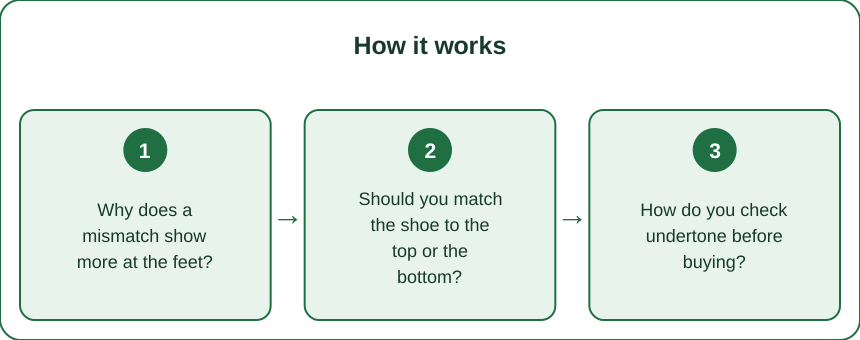
Why does a mismatch show more at the feet?
Two reasons, one visual and one material.
The eye finishes at the bottom. When you look at a person head to toe, the last thing you process is the shoe. A near-miss there is the impression you leave with, in a way that a near-miss between two mid-body layers is not.
Shoe materials handle light completely differently. A suede in warm sand absorbs light and reads deeper. The same sand in a smooth leather reflects and reads lighter and cooler. A knit upper in the identical dye lot reads different again because the texture creates micro-shadow.
So two items that are genuinely the same color on paper can read as two different colors in a mirror. This is a material problem masquerading as a color problem, which is why matching swatches online so often fails.
Add the sole. A bright white rubber sole under a warm beige upper introduces a cool element right at the base of the outfit, which is why so many neutral sneakers fight warm-toned clothing even when the upper is a perfect match.
Should you match the shoe to the top or the bottom?
The bottom, almost always.
Matching a shoe to your legging, trouser, or skirt hem creates continuity in the lower half and visually lengthens the leg. The eye reads leg-plus-shoe as one unbroken section, which is the same principle behind monochrome dressing.
Matching the shoe to a top does the opposite — it creates a visual bracket that draws attention to the two ends and emphasizes the break in the middle. It can be done deliberately, but it is a considered styling choice rather than a default.
The most forgiving option is matching the shoe to your skin tone rather than to any garment. A shoe close to your own undertone extends the leg line further than any garment match does, which is the entire logic behind nude footwear.
When nothing matches cleanly, go a shade darker rather than lighter. A shoe darker than the hem reads as a deliberate anchor; a shoe lighter than the hem reads as an accident.
How do you check undertone before buying?
Three quick tests, none of which require expertise.
Compare against white paper. Hold the shoe next to a plain white sheet. Warm neutrals will show yellow, peach, or olive. Cool neutrals will show grey, pink, or blue. This test is more reliable than looking at the shoe alone, where your eye adapts within seconds.
Photograph it next to the garment. Your eye colour-corrects continuously; a camera does not. Photographing the shoe beside the legging under daylight will show a mismatch your eye was smoothing over.
Check it under two light sources. A warm indoor bulb and daylight. A pairing that only works under one light source is not a match — and shop lighting is engineered to be flattering.
One shortcut that saves a lot of trouble: greige and taupe are the most versatile neutral shoe colours because they sit between warm and cool and read as a bridge rather than as a commitment. If you want one neutral shoe that works with the most outfits, that is the range to shop in.

Myth vs Fact: Neutral Footwear
Myth: Nude shoes should match your skin exactly. Fact: Close is better than exact. A shoe slightly deeper than your skin tone reads more intentional and hides marks far better, while an exact match tends to look flat in photographs.
Myth: White sneakers go with everything. Fact: White works with most things but it is a cool bright, and against warm cream or camel it introduces a visible contrast at the hem. Off-white or bone is the more compatible choice for warm neutral outfits.
Myth: Suede is too impractical for regular wear. Fact: Treated suede handles dry autumn conditions well and is more forgiving of scuffs than smooth leather. It is genuinely bad in wet weather, which is a seasonal limitation rather than a permanent one.
Myth: Matching your bag to your shoes is outdated. Fact: Matching exactly is. Matching undertone — both warm, or both cool — still does real work, and it is the version of the rule worth keeping.
Myth: Neutral shoes are a safe purchase. Fact: They are the least safe neutral purchase, precisely because of the undertone and material issues above. A neutral top is genuinely low risk; a neutral shoe needs to be seen against your actual wardrobe first.
What changes when you add autumn layers?
The whole neutral balance shifts as heavier fabrics enter.
Summer neutrals tend to be light and cool — white, stone, pale grey. Autumn neutrals run warm and deep: camel, chocolate, olive, oatmeal. A shoe that anchored your summer outfits perfectly can look thin and out of season against a wool coat, without the shoe having changed at all.
Material weight matters too. A canvas or knit sneaker under a heavy knit and a wool trouser looks underweight, regardless of colour. Leather, suede, and lug soles carry more visual mass and balance seasonal fabrics better.
This is also when socks re-enter, and socks are a colour decision people make without thinking. A white sport sock under a warm neutral trouser is a contrast break at exactly the wrong height. Match the sock to the trouser or to the shoe, not to your gym drawer.
And boot season introduces the shaft, which means a much larger area of colour at the ankle. Undertone errors that were forgivable on a low sneaker become considerably more visible on a boot with four inches of upper.
FAQ: Neutral Shoe Questions, Answered
What is the single most versatile neutral shoe colour?
A mid-tone greige or taupe, in a low-profile silhouette. It bridges warm and cool, sits close to most skin tones, and hides wear better than either cream or white.
How do I stop light neutral shoes from looking dirty?
Protective spray when new, a soft brush weekly, and a dedicated cleaner for the sole edge — which is usually what actually looks grubby rather than the upper. Rotating two pairs roughly doubles how long each stays presentable.
Can I wear black shoes with a warm neutral outfit?
Yes, and it is often better than a near-miss beige. Black reads as a deliberate anchor rather than a failed match. The pairing to avoid is black shoes with cream when nothing else in the outfit is dark — the shoe ends up floating with no relationship to anything above it.
TL;DR:
- Neutral shoes are harder because the eye finishes at the feet and because materials render the same colour differently.
- Match the shoe to your hem or your skin tone, not to your top.
- Test undertone against white paper, in a photo, and under two light sources before committing.
- When in doubt, go darker than the hem — a darker shoe reads intentional, a lighter one reads accidental.
Photograph your most-worn neutral shoe next to your most-worn neutral legging in daylight. If the two do not read as related, you have found why that outfit never quite worked.
See It in Motion
Seen here: High Waist 8” Yoga Shorts — shop similar styles on bubblelime.com
Keep Reading
This article is for general informational and styling purposes only. Fit, sizing, and product availability may vary.