How Many Neutrals Can You Wear at Once? The Three-Shade Rule

Quick Answer: Three distinct neutral shades is the reliable ceiling for one outfit — a light, a mid, and a dark drawn from the same temperature family — because three creates depth while staying calm, two can read flat without texture help, and four-plus starts to look accidental. The supporting rules do the rest: keep undertones matched (warm with warm, cool with cool), put meaningful contrast between any two pieces that touch, and let texture multiply a shade so it counts twice without adding a new color. Beige soup is never a neutrals problem; it is a same-value, same-texture problem.
The all-neutral outfit is the highest-floor, lowest-effort look in the entire wardrobe game — when it works. When it fails, it fails as mush: five almost-identical beiges blending into one long undifferentiated garment. The fix is not more color. It is treating neutrals as what they secretly are — colors, with values and undertones that either structure an outfit or dissolve it.

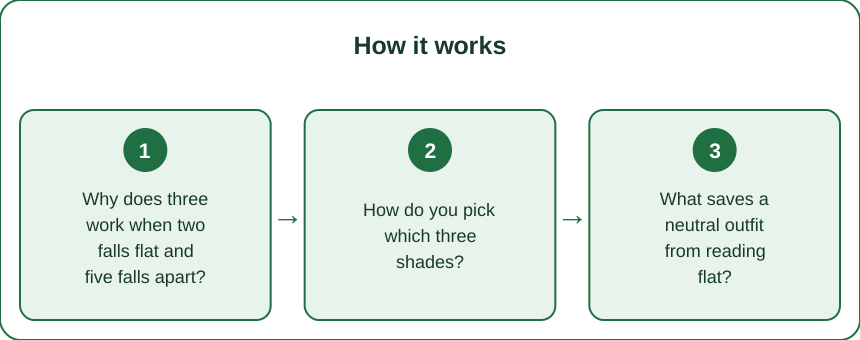
Why does three work when two falls flat and five falls apart?
Because an outfit reads through value structure — the light-to-dark map your eye takes in before it registers a single garment.
Three shades gives the eye a complete composition: a light, a mid, and a dark create foreground, body, and anchor. The outfit has places for attention to land and edges where pieces begin and end. This is the same logic interior designers and painters run — a value triad is the minimum for depth and the maximum before competition starts.
Two shades can work but has no margin. Cream and camel with nothing else relies entirely on texture and silhouette to create separation; in matching smooth fabrics it flattens into that soup. Two-shade outfits are an advanced move dressed as a simple one.
Four and five shades lose the plot — not because any pairing clashes, but because the value map stops having a hierarchy. Which piece anchors? Where does the eye rest? Nothing answers, and the outfit reads as assembled from whatever was clean, which is often exactly what happened.
The count that matters is distinct shades, not garments: seven pieces in three shades (coat and boots in chocolate, knit and bag in camel, tee and trousers in cream — six items, three shades) reads composed, while three pieces in three unrelated neutrals can still misfire on the rules below. Count shades, not hangers.
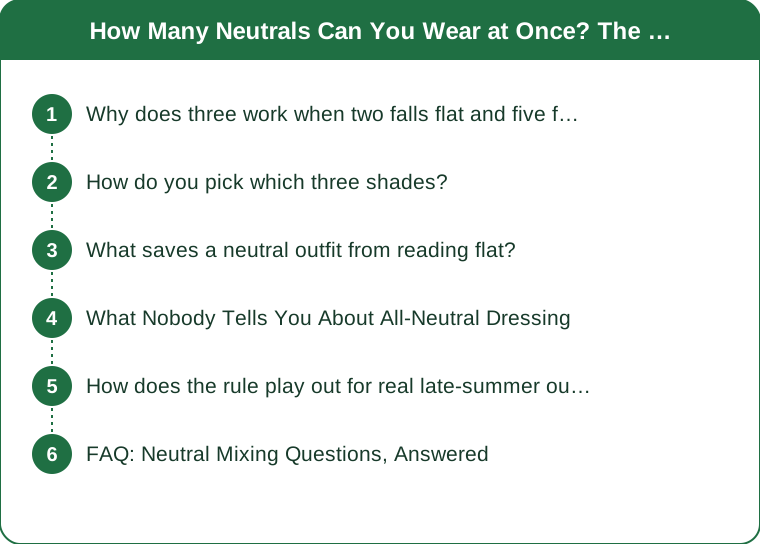
How do you pick which three shades?
Build a ladder, then check the temperature.
The ladder: one light, one mid, one dark, with real space between rungs. Light: cream, ivory, oat, soft white. Mid: camel, taupe, greige, mushroom, stone. Dark: chocolate, espresso, charcoal, deep olive, black. The classic failure is three shades from the same rung — oat, sand, and beige are one shade wearing three names, and an outfit built from them is a two-rung ladder pretending otherwise. If two pieces look the same in a dim room, they are the same rung; separate them with a piece from another rung or save one for a different day.
The temperature check: neutrals carry undertones, and undertones argue. Warm family: cream, camel, tan, chocolate, warm olive. Cool family: optic white, gray, greige-leaning-gray, charcoal, black. Mixing families is what produces that unnameable off feeling — a warm camel coat over a cool gray knit looks slightly wrong from across the street even to people who cannot say why. Pick one family per outfit; the mixed-family exceptions exist but they are styled on purpose by people doing it on purpose.
Then let one shade dominate. Roughly 60 percent of the outfit in your base shade, 30 in the second, 10 in the accent — the interior-design ratio ports to clothing intact. Dominant dark with light accents reads polished and grounded; dominant light with a dark anchor reads soft and expensive; even thirds reads undecided.
Write your best ladder down once — most wardrobes contain two or three great ones already.
What saves a neutral outfit from reading flat?
Contrast where pieces meet, and texture everywhere else.
The adjacency rule: any two garments that physically touch should sit at least one full rung apart. Cream tee under camel cardigan: adjacent and separated, works. Camel tee under camel cardigan: one long beige tube, needs the third shade at the neckline, waist, or feet to cut it. Run the check at every border — top-to-bottom, layer-to-layer, hem-to-shoe — and the soup risk drops to zero without adding a single item.
Texture is the multiplier that lets one shade count twice. Chunky knit, smooth ponte, suede, leather, rib, satin — two pieces in the same camel but opposite textures read as deliberate tonal styling, not as a matching mistake. This is the entire mechanism behind expensive-looking monochrome: the shades match while the surfaces argue. It is also the athleisure version’s whole trick — an oat rib-knit top over cream buttery-soft leggings with chocolate accessories is three textures, two rungs, and reads far more styled than its comfort level admits.
Metal and material accents carry the 10 percent. Gold jewelry warms a warm ladder; silver cools a cool one; tortoiseshell, horn buttons, woven leather, and a contrast sole all add interest inside the palette without breaking it.
And one deliberate line helps: a tucked waist, a belt, a boot cutting the leg — neutrals reward silhouette structure because nothing loud is distracting from it. The calmer the palette, the more the proportions are the outfit.

What Nobody Tells You About All-Neutral Dressing
Skin, hair, and undertone are the fourth shade. An all-neutral outfit puts your own coloring on the team whether invited or not — the frame around your face is doing the accent work color normally does. Warm-toned complexions generally sit easiest inside the cream-camel-chocolate family; cool-toned inside white-gray-black; and the shade that goes right at your jawline deserves the same daylight audition as any monochrome color. The practical version: when a neutral outfit feels inexplicably draining, swap which rung sits nearest your face before swapping the outfit.
White and black are neutrals with sharp elbows: optic white is the loudest “neutral” that exists — in a soft warm ladder it reads like a flash going off — and true black hardens a cream-camel outfit the way a marker line hardens a pencil sketch. Both are magnificent inside their own cool family; both are the most common saboteurs smuggled into warm ones. Cream and espresso are the warm ladder’s white and black, and most beige-soup rescues are just that substitution.
Fabric quality is more visible in neutrals than anywhere else — with no print or color to carry attention, surface is the whole story, and pilling, shine, and limpness read from twice the distance. The neutral capsule argument was always secretly a buy-fewer-better argument.
And the reassuring one: neutrals photograph better than they mirror. The outfit that felt too quiet at home reads intentional and calm in every photo from the event — flat light loves a value ladder. Trust the three-rung math over the closet-mirror doubt.
How does the rule play out for real late-summer outfits?
Three ladders, dressed for the weeks between now and sweater season.
The warm classic — cream, camel, chocolate. Now: cream linen shirt open over a camel ribbed tank, cream wide-leg trousers, chocolate slides and belt. Transition: swap linen for a camel fine-gauge crew tied at the shoulders, add chocolate ankle boots when evenings cool. The 60-30-10 lands as cream-dominant, camel-supporting, chocolate-anchoring — the softest version of put-together that exists.
The cool city ladder — optic white, gray, black. White tee, heathered gray relaxed trousers or a gray knit skirt, black minimal sneakers, silver jewelry. This ladder tolerates the athleisure register best: white tank, gray marl half-zip, black yoga pants and clean black trainers is a school-run and coffee outfit that never reads as gym-bound because the values are doing composition work.
The deep transitional — oat, olive, espresso. The ladder that meets fall halfway: oat tee, olive utility overshirt, espresso straight-leg pants now; the same skeleton takes a knit and boots in October without buying a shade. Olive functions as a mid-rung neutral against warm companions — the honorary neutral that adds the most freshness per rule broken, which is none.
Across all three, the same checks run in seconds: three rungs present, one family only, contrast at every border, one texture argument, one structural line. Five checks, no color theory degree, and the beige soup never gets served.
FAQ: Neutral Mixing Questions, Answered
Is denim a neutral in this system?
Functionally yes — mid-blue denim behaves as a cool-leaning mid rung, and white-tee-plus-denim-plus-camel is the classic sanctioned family mix because denim’s texture excuses it. Count it as one of your three shades, not as a freebie: denim plus three other neutrals is a four-shade outfit with the usual four-shade problems.
Do shoes and bags count toward the three shades?
They count, and they are the best place to put the dark rung or the 10 percent accent — a chocolate boot-and-bag pair anchors a cream-and-camel outfit with zero effort. The common miss is a fourth neutral arriving via a gray sneaker on a warm outfit; shoe undertones follow the same family rule as everything else.
What about leopard, tortoiseshell, and metallics — do they break the count?
Small-scale classic patterns built from neutral colors (leopard in camel-black, tortoiseshell, snake in taupe) function as textured neutrals and slot into the 10 percent accent without counting as a new shade. A leopard coat is different — at that scale it is the outfit’s main event and the ladder should quiet down to two rungs around it.
Can I wear a neutral outfit to an event without looking underdressed?
Yes — formality in neutrals comes from fabric and silhouette, not color: a cream satin skirt with an oat knit and espresso heels is unmistakably dressed up. The event risk is texture-flatness, not color-quietness; bring one luminous surface (satin, silk, polished leather) and the outfit reads considered in any room.
TL;DR:
- Three distinct shades — light, mid, dark from one temperature family — is the sweet spot: depth without noise. Count shades, not garments.
- Keep warm neutrals (cream, camel, chocolate) and cool neutrals (white, gray, black) in separate outfits; mixed families are why an outfit feels off from across the street.
- Enforce contrast wherever two pieces touch, run 60-30-10 dominance, and let texture make one shade count twice.
- Optic white and true black are cool-family players — cream and espresso are their warm-family stand-ins, and that swap rescues most beige soup.
Open the closet and build one three-rung ladder from what is already hanging there — most wardrobes own two complete ones without knowing it. Wear it tomorrow and notice how much styling the value map did while you slept.
See It in Motion
Seen here: Super High Waist Embossed Yoga Leggings with Inner Pocket — shop it on bubblelime.com
Keep Reading
This article is for general informational and styling purposes only. Fit, sizing, and product availability may vary.